Fabric vs Forge vs Paper: which server type should you pick?
"What software should my server be: Paper, Fabric, Forge?" is one of the first real forks in setting up a server. Here's the honest difference between plugins and mods, and how to pick the one your friend group actually needs.
Once you've got a server, you hit a menu asking what software to run it on (Paper, Spigot, Purpur, Fabric, Forge), and it's genuinely confusing because the names don't tell you what they do. This is one of the most-asked setup questions on every host.
The whole thing comes down to one split: do you want plugins or mods? Get that answer and the choice basically makes itself. Here's what each family is actually for, so you pick by what your group wants to play instead of guessing.
In this guide
Which one should you pick?
- Already found a modpack → nothing to decide. The pack picked the loader and you match it; this is the most common answer on this page.
- Want claims, homes, or a shop, but the game itself unchanged → Paper (or Purpur) with a few plugins. Your friends install nothing and join like any other server.
- Want mods but haven't picked a pack → look up where your must-have mods are published. Fabric for lighter sets and quicker updates after a release, Forge or NeoForge for the big content mods.
- Just want plain Minecraft with friends → vanilla. A real answer, and the one nobody recommends because there's nothing to sell you with it.
At a glance
Fabric mods and Forge mods are not interchangeable: a mod is built for one loader. Spigot is the older project Paper grew out of, and NeoForge is a fork of Forge that a lot of modern packs moved to.
Know the one split: plugins vs mods
Server software divides into two families. One runs plugins: server-side add-ons that change how the server behaves (permissions, mini-games, economy, anti-grief) without anyone installing anything. The other runs mods: content that changes the actual game (new blocks, mobs, dimensions, machines), which usually means every player installs the mods too.
That's the fork the whole decision hangs on, and the cost of getting it wrong is asymmetric: choosing plugins when you wanted mods is a mild disappointment, while choosing mods when you wanted plugins means five friends installing files before anyone can play. Almost everything else is a detail under those two.
Paper (and Spigot, Purpur): plugins and performance
Best for: A survival world with quality-of-life plugins, where friends should be able to join with an unmodified game.Not for: Anyone whose plan is new blocks, machines, dimensions, or a modpack.
Paper is the go-to for a plugin server: it runs Bukkit/Spigot plugins, performs noticeably better than vanilla under load, and keeps the game feeling vanilla for your friends: nobody has to install anything to join. Spigot is the older project Paper grew out of; Purpur is a Paper fork with extra tweaks.
Pick this family for a survival SMP or a friends' world where you want plugins (homes, claims, a bit of economy, a mini-game) but not a whole modded game. It's the common choice for "vanilla-ish, but nicer to run", and on a server that's struggling it's usually a bigger win for tick time than buying more RAM.
The catch
Plugins work with the game Mojang shipped: they can rearrange, restrict and script it, but they can't add a genuinely new block or mob the way a mod does. And Paper's performance work changes a handful of vanilla quirks by default (several duplication glitches are patched out), which is usually a good trade and occasionally the reason a farm from a YouTube video doesn't work on your server.
Fabric and Forge (and NeoForge): mods
Best for: A group who want the game itself to be different, and who'll all install the same pack to get there.Not for: A group where getting five people onto the same launcher is the hard part: that friction is real, and it lands on the person who set the server up.
If you want a modded game (tech mods, magic, big modpacks like All The Mods or RLCraft), you need a mod loader, and the two families are Fabric and Forge. Fabric is lightweight and stays easy to run. Forge is the original heavyweight, but NeoForge (the fork of it that most modern packs have moved to) is now where the big content mods actually are, so "Forge" in practice usually means NeoForge.
In practice you rarely pick the loader directly. A modpack has already chosen one, and the mods you personally want are published for one family or the other, so the honest method is to look up your must-have mods and let them decide, rather than arguing the loaders on their merits.
The catch
Everyone installs the mods, matched to the server's loader and Minecraft version, and mods are not portable between families: a Fabric mod will not load on Forge. Mod availability also lags a Minecraft release by weeks or months, so "we'll update to the newest version" and "we're playing this modpack" are frequently not both possible at once.
Vanilla: the answer this question forgets
Best for: A new world, a group who just want to play tonight, and nobody with a specific mod in mind.Not for: A busy server: vanilla is the slowest of these under load, and Paper is a free fix for that when the day comes.
The official server jar runs no plugins and no mods, and for a lot of friend groups it's the right call. Nobody installs anything, nothing breaks on a Minecraft update, and there's no evening spent matching versions before anyone gets to play.
It's worth naming because the question "Paper, Fabric, or Forge?" assumes you need one of them. If nobody in your group has actually asked for a mod or a plugin yet, start here. Swapping to Paper later is a small job, and you'll know by then what you actually wanted.
Set it (and switch it) without the manual wrangling
On Voxi you set your server's software from a validated catalog in one place, or pick a modpack straight from CurseForge or Modrinth and the matching loader is set up for you: no hunting down loader installers and matching version numbers by hand.
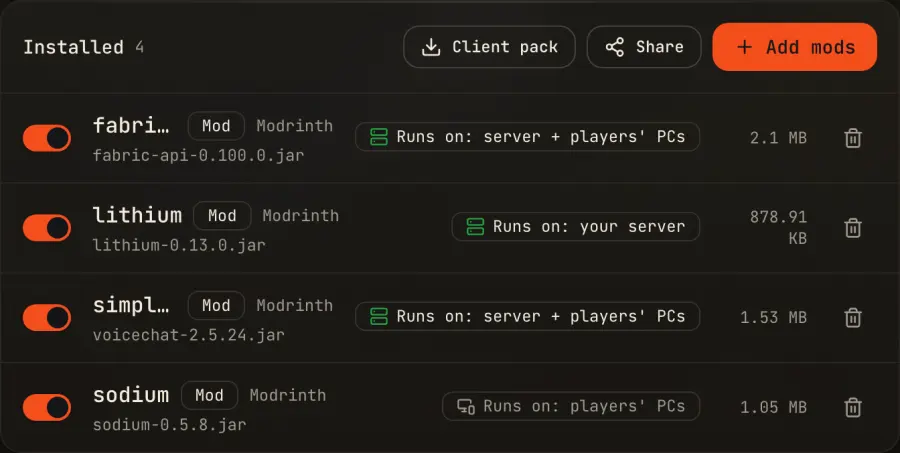
Voxi also labels every mod by where it runs (your server, players' computers, or both), so a client-only mod reads plainly as "won't do anything here" instead of quietly crashing the boot. Worth being clear about what's being sold, though: Paper, Fabric and Forge are free downloads that anyone can install on any box. What a host saves you is the version-matching and the file wrangling, not the software.
The catch
Switching families later is not free. Going from plugins to mods (or back) changes what your world contains and what every friend has to install, and blocks or items added by mods you drop don't survive the move. Back the world up before you change software, not after.
FAQ
What's the difference between Fabric, Forge, and Paper?
Paper runs plugins and performs well while keeping gameplay vanilla-ish (nobody installs anything to join). Fabric and Forge are mod loaders for changing the actual game: Fabric is light and quick to update, and NeoForge, the Forge fork most modern packs have moved to, carries the deepest big-mod catalog.
Which server type should I pick for a modpack?
Whichever loader the modpack is built for: the pack decides it for you, so choose the pack first and match its loader and version. On Voxi you can pick a pack from CurseForge or Modrinth and the matching loader is set up automatically.
Can I switch my server type later?
Yes. On Voxi you can change your server's software from the catalog. Switching between the plugin family (Paper/Spigot/Purpur) and the mod family (Fabric/Forge) changes what your world and your friends need, and blocks added by mods you drop don't survive the move, so back up your world before you do it.
Is Fabric or Forge better?
Neither, in the abstract. Look up where the mods you actually want are published: Fabric tends to be usable sooner after a Minecraft release and suits lighter sets, Forge and NeoForge carry the big content mods. If you've chosen a modpack, it has already decided this for you.
Do I need Paper, or is vanilla enough?
Vanilla is enough until somebody asks for a plugin or the server starts struggling under load. Paper runs plugins and handles load better while keeping gameplay vanilla-ish, and moving to it later is a small job.
Read next: how to install a modpack on your Minecraft server.
Comparing hosts? See how Voxi compares to Aternos, Minehut, Exaroton and the paid hosts.
Pick the software, skip the installers
Start a free server on Voxi, choose Paper, Fabric, Forge or vanilla from the catalog, or pick a modpack and get its loader set up for you. Paper and the loaders are free downloads. If you already run a box, you don't need us to get any of them.